GuidesEU Parcel Rules 2026: New €3 Customs Duty Explained for UK Sellers
Fulfilment Finder·13 June 2026
From 1 July 2026 the EU scraps its €150 de minimis threshold and charges €3 duty per item on low-value parcels. What UK ecommerce businesses must do now.
The end of small mercies
From July 1st 2026, every parcel entering the European Union will pay customs duty. Britain's online sellers have three weeks to adapt
For nearly two decades, the trinkets of global ecommerce slipped into Europe through a side door. Any parcel worth less than €150 entered the European Union free of customs duty, a concession known as the de minimis exemption, designed in a gentler era when small parcels were a rounding error in trade statistics. They are no longer. According to the European Commission, some 4.6 billion low-value parcels arrived in 2024; by 2025 the figure had reached almost 5.9 billion, the overwhelming majority despatched directly from China by the likes of Shein and Temu. On July 1st, the side door closes.
The politics of the change are aimed squarely at Shenzhen. The consequences, however, will land on anyone posting a parcel into the bloc — including the tens of thousands of British businesses for whom the EU remains, even after Brexit, the largest customer on the doorstep. For them, the next few weeks are not a policy debate but an operational deadline.
What is actually changing on July 1st 2026
The legal machinery moved with unusual speed. The Commission first proposed scrapping the €150 threshold in May 2023, as part of a sweeping customs reform due to mature in 2028. But the flood of cheap imports — and America's abolition of its own $800 de minimis rule in August 2025 — concentrated minds. EU finance ministers struck a political deal in November 2025, with the trade commissioner, Maroš Šefčovič, declaring the original 2028 timetable "incompatible with the urgency of the situation". The Council formally adopted the package, Council Regulation (EU) 2026/382, in February 2026. Implementing rules were published in the EU's Official Journal on June 8th, barely three weeks before they bite.
The headline change is this: from July 1st 2026, the duty exemption for consignments worth €150 or less is abolished. In its place, until the EU's new Customs Data Hub goes live on July 1st 2028, sits a transitional flat-rate duty of €3 per item. Crucially, "item" means tariff classification, not physical unit. A parcel containing five t-shirts attracts one €3 charge, because they share a commodity code. A parcel containing a t-shirt and a watch attracts €6, because it contains two. Mixed baskets, the bread and butter of direct-to-consumer retail, multiply the bill.
The duty is levied on the declarant — typically the seller registered under the Import One-Stop Shop (IOSS) VAT scheme, or their customs representative — rather than charged to the consumer at the doorstep, though sellers will be under no illusion about where the cost ultimately travels. VAT arrangements are unchanged: import VAT has applied to all parcels since the €22 VAT exemption died in 2021, and IOSS remains the cleanest way to collect it.
Nor is the €3 the end of it. A separate EU-wide handling fee — proposed at €2 per consignment — is still being negotiated, with the amount and start date expected to be settled in autumn 2026. Impatient member states have not waited: Italy and Romania introduced national processing fees on low-value imports in January 2026, and France began charging €2 per item on March 1st. Belgium and the Netherlands have signalled similar intentions. From November 1st 2026, parcels will also require mandatory product identifiers (PIDs), machine-readable codes that let customs authorities trace and block unsafe goods; they can be declared voluntarily from July.
The Commission's justification leans heavily on consumer protection as well as fairness. Its own reform analysis found that up to 65% of low-value parcels entering the bloc were undervalued to dodge charges. Targeted inspections across the EU in 2025 — covering cosmetics, toys, electronics, food supplements and protective equipment — found that over 60% of checked products failed EU standards. Whatever one thinks of the remedy, the diagnosis is hard to dispute.
The transitional regime expires on July 1st 2028, when the Customs Data Hub becomes operational and low-value imports move to proper tariff treatment — expected to take the form of simplified duty brackets reported at 0%, 5%, 8%, 12% and 17% depending on the product. The €150 exemption, once gone, is gone for good.
What it means for UK businesses selling into the EU
Britain is collateral damage in a war on container-loads of polyester. Since 2021 it has been a "third country" for customs purposes, which means British parcels are caught by rules drafted with China in mind. The exposure is considerable: the EU took 41% of all British exports in 2025, and goods exports to the bloc were worth £177bn in 2024 — still below their pre-Brexit peak. A large share of small-business trade moves precisely in the sub-€150 consignments the new regime targets.
The most painful irony concerns the Trade and Cooperation Agreement. On paper, goods of genuine UK origin enter the EU tariff-free. And the new rules do carve out goods benefiting from preferential trade agreements — but only where VAT is not collected through IOSS and the goods are entered on a full standard customs declaration. For a £25 parcel, the cost of a formal declaration and the paperwork of proving origin will usually exceed the €3 it saves. Most small sellers will rationally stay inside IOSS and swallow the duty. The TCA's zero tariffs, already underused — in textiles and clothing, only between 10% and 53% of UK exports to the EU claimed them in 2022, according to research cited by the House of Commons Library — become harder still to monetise at parcel scale.
The arithmetic deserves attention. Consider a £30 basket containing a candle, a greetings card and a tube of hand cream: three tariff headings, therefore €9 in duty, before France's €2 per-item fee, the prospective EU handling fee and whatever brokerage charge the carrier adds. On low-margin orders, charges of that order can consume the profit entirely. Sellers shipping Delivered Duty Paid absorb the hit directly; those shipping Delivered At Place pass it to customers, along with the delivery delays and doorstep demands that reliably poison reviews and kill repeat purchases.
Then there is the data burden. Every parcel now needs an accurate six-digit HS code, a defensible valuation, a stated country of origin and, from November, product identifiers. Customs authorities that once waved low-value post through will be inspecting it with revenue in mind. Sloppy data, long a tolerated vice of small-parcel exporting, becomes a source of holds, returns and penalties.
How UK ecommerce businesses can prepare
The good news, such as it is, is that the playbook is clear, and the businesses that move first will take share from those that dither.
Start with data hygiene. Audit every SKU for correct HS classification at six digits, honest intrinsic values and accurate origin records, and make sure your EORI details, IOSS registration and carrier data feeds are aligned. This is unglamorous work, but it is the difference between parcels that clear in hours and parcels that sit in a Rotterdam shed. Begin capturing product identifiers now rather than in a panic in October.
Next, run the IOSS arithmetic honestly. For most low-value, multi-line orders, remaining in IOSS and paying €3 per tariff heading will be cheaper and smoother than formal entry. But for single-line consignments of genuine UK-origin goods at the upper end of the €150 band, a standard declaration claiming TCA preference may beat the flat fee. The answer differs by product; model it rather than assume it.
Third, re-engineer the basket. Because duty is charged per tariff heading, range architecture is suddenly a customs strategy. Bundles built within a single commodity code attract one charge where a grab-bag of categories attracts several. Raising free-shipping thresholds spreads the fixed duty across a larger order. Above all, show the full landed cost at checkout and ship DDP: in a world of doorstep charges, "no surprises" is a competitive weapon.
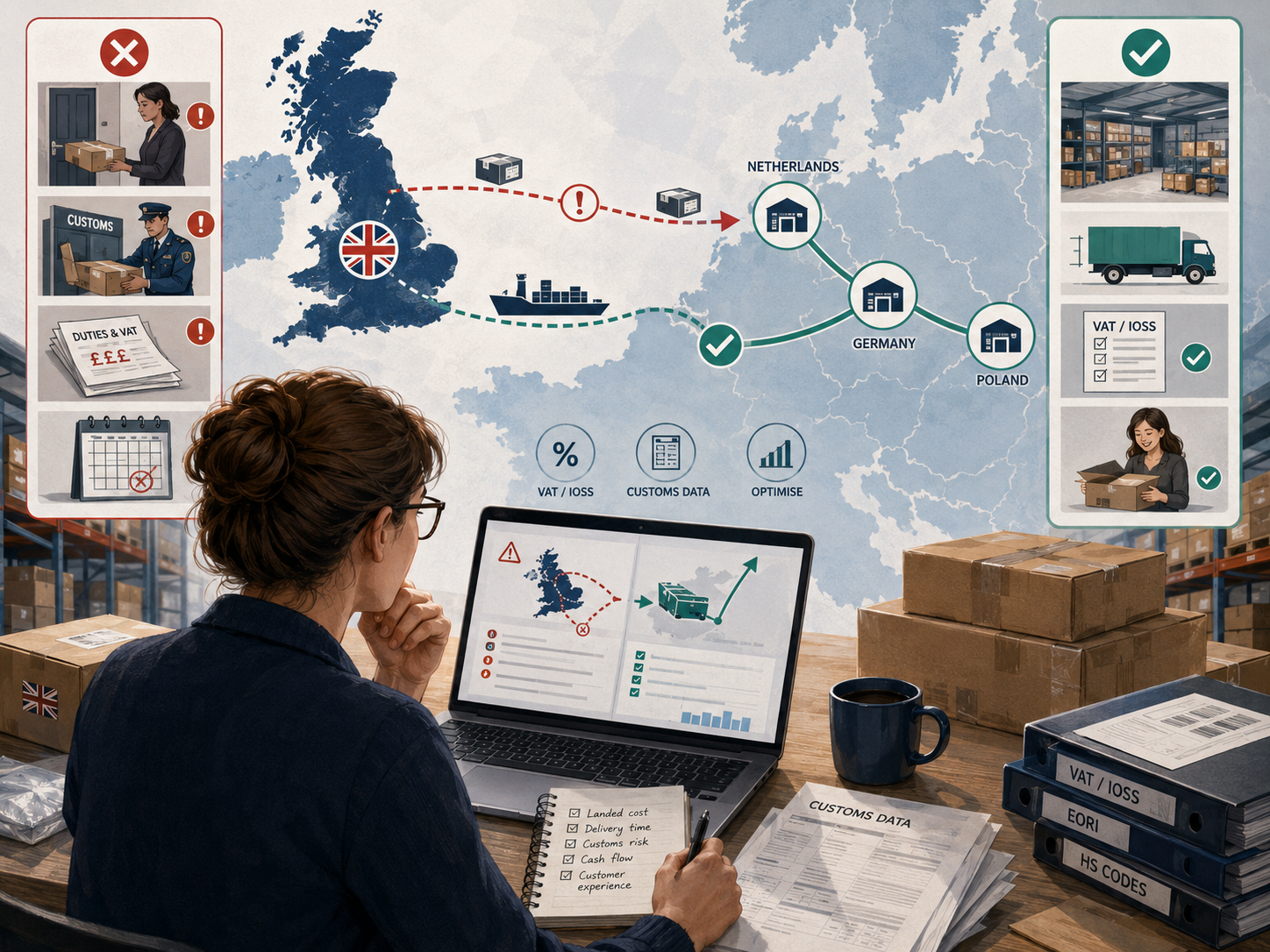
Fourth, weigh EU fulfilment seriously. The structural answer to per-parcel friction is to stop sending parcels across the border at all. Importing in bulk — at trade tariffs, which for TCA-qualifying goods means zero — into a fulfilment centre in the Netherlands, Germany or Poland converts thousands of customs events into one, restores next-day delivery and sidesteps the national handling fees stacking up across the bloc. It is not free: it demands an EU VAT registration, fiscal representation in some states and working capital tied up in stock. But for brands with meaningful EU volume, the case that was strong after Brexit is now close to conclusive, and warehouse capacity in the favoured hubs is already tightening.
Fifth, get your carriers and platforms on record. Ask precisely who will act as declarant from July 1st, what brokerage and disbursement fees they intend to levy, how they will handle France's per-item charge, and how they plan to pass through the EU handling fee when it lands in the autumn. Several carriers are still finalising their approach; sellers who negotiate now will fare better than those who discover surcharges on an August invoice.
Finally, lift your gaze to 2028 — and homeward. The €3 levy is a bridge, not a destination; the full tariff regime arrives with the Customs Data Hub in two years, and product-level duty rates will then matter again. Meanwhile Britain is following the same road in the other direction: the Autumn Budget 2025 confirmed that the UK's own £135 duty-free threshold will be abolished, with reforms due by March 2029. The era of the frictionless small parcel is ending on both sides of the Channel.
For British ecommerce, the lesson of July 1st is uncomfortable but useful. Customs data, duty engineering and fulfilment geography are no longer back-office trivia; they are pricing, conversion and brand experience by other means. The sellers who treat them that way will find that Europe, for all its new tolls, remains very much open for business. The rest will learn what €3, multiplied by everything, really costs.
Sources: European Commission (DG TAXUD) guidance, June 2026; Council Regulation (EU) 2026/382; Council of the EU press releases, November–December 2025; House of Commons Library; ONS; Royal Mail European Trade Insights.